> ## Documentation Index
> Fetch the complete documentation index at: https://docs.cloudify.biz/llms.txt
> Use this file to discover all available pages before exploring further.
# Product Sync Rules
> Control how Shopify products are matched, created, and mapped in e-conomic
Product Sync Rules control how the app finds your products in e-conomic, what happens when a product does not exist there yet, and which product data is copied over.
You find these settings on the **Sales Posting Setup** page, under the **Product** tab.
## Choose a product search method
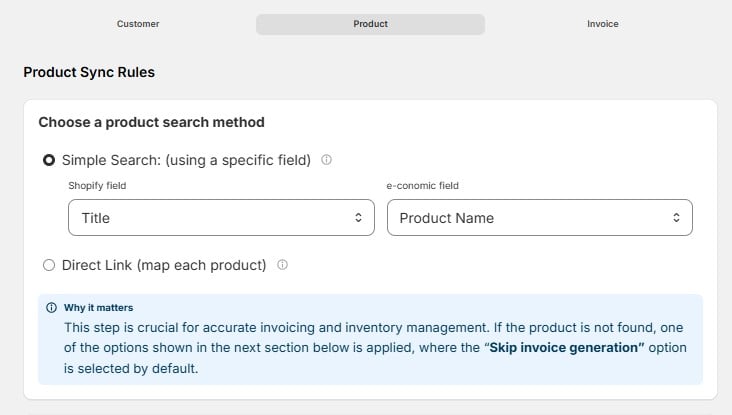
When an order comes in, the app needs to find the matching product in e-conomic so it can put the right product line on the invoice. There are two ways to do this:
* **Simple Search (using a specific field)** – the app matches products by comparing one Shopify field to one e-conomic field. The default is Shopify **Title** matched against e-conomic **Product Name**. Select the most reliable field for identifying your products — something that is always filled out and unique to each product. If your SKUs are consistent, matching Shopify **SKU** against e-conomic **Product Number** is a strong choice.
* **Direct Link (map each product)** – instead of matching by a field, you manually link each Shopify product to its e-conomic product one by one. This gives you full control but takes more work, and every new product must be linked before it can sync.
This step matters for accurate invoicing and inventory. If a product cannot be found, the app falls back to the rule you choose in the next section — and the default fallback is to skip invoice generation entirely.
 ## If product not found in e-conomic
This rule decides what happens when an order contains a product that the search method could not find in e-conomic:
## If product not found in e-conomic
This rule decides what happens when an order contains a product that the search method could not find in e-conomic:
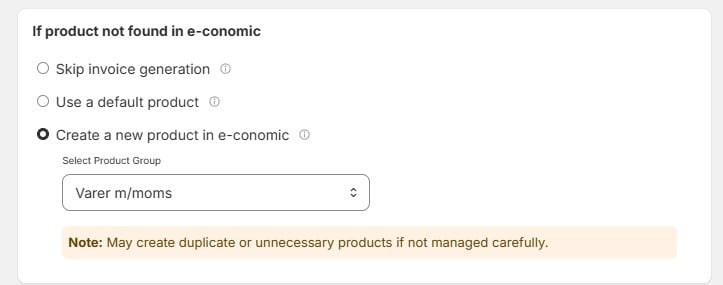 * **Skip invoice generation** (default) – the integration stops for that order and no e-conomic invoice is created. This prevents errors, but you need to manually review each order with a product mismatch.
* **Use a default product** – the invoice is created using a pre-selected e-conomic product. Only the **product number** of the selected default product is used for invoicing — all other details (name, price, quantity) still come from the Shopify order. This keeps the integration running, but the affected invoices may need manual review later.
* **Create a new product in e-conomic** – the app automatically creates the missing product in e-conomic from the Shopify product details and uses it on the invoice. You select which **Product Group** new products are placed in (for example "Varer m/moms" – goods with VAT), which determines the sales account for new products. This ensures all products sync.
Automatic product creation may create duplicate or unnecessary products if not managed carefully — for example if the same product exists in Shopify with slightly different titles. Keep your product data clean if you use this option.
## Tax settings
**Exclude Shopify Tax from e-conomic invoices** – enable this checkbox to remove the taxes applied on the Shopify order when the e-conomic invoice is created. Only the relevant e-conomic tax is applied to the invoice instead.
* **Skip invoice generation** (default) – the integration stops for that order and no e-conomic invoice is created. This prevents errors, but you need to manually review each order with a product mismatch.
* **Use a default product** – the invoice is created using a pre-selected e-conomic product. Only the **product number** of the selected default product is used for invoicing — all other details (name, price, quantity) still come from the Shopify order. This keeps the integration running, but the affected invoices may need manual review later.
* **Create a new product in e-conomic** – the app automatically creates the missing product in e-conomic from the Shopify product details and uses it on the invoice. You select which **Product Group** new products are placed in (for example "Varer m/moms" – goods with VAT), which determines the sales account for new products. This ensures all products sync.
Automatic product creation may create duplicate or unnecessary products if not managed carefully — for example if the same product exists in Shopify with slightly different titles. Keep your product data clean if you use this option.
## Tax settings
**Exclude Shopify Tax from e-conomic invoices** – enable this checkbox to remove the taxes applied on the Shopify order when the e-conomic invoice is created. Only the relevant e-conomic tax is applied to the invoice instead.
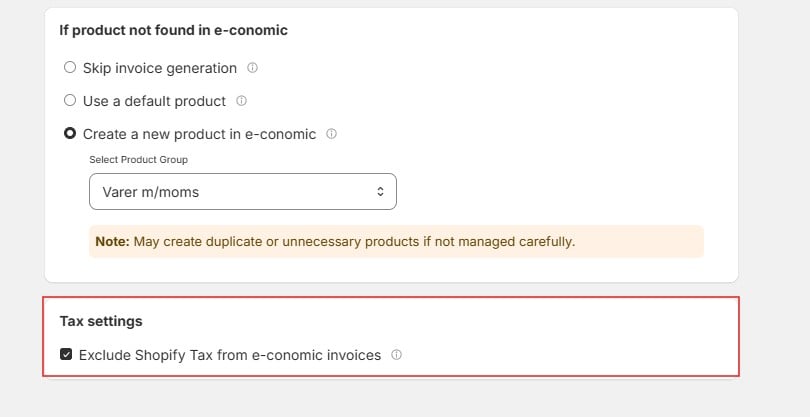 Cloudify does not perform any tax calculations. The tax on the invoice depends entirely on your existing tax settings in e-conomic. This checkbox only controls whether the Shopify tax amount is carried over or left out.
## Product Field Mappings
This table only applies if you chose **Create a new product in e-conomic** above. It defines which Shopify product data is copied into which e-conomic field when a new product is created.
The **Status** column shows the state of each field:
* **Mapped** (green) – the e-conomic field is filled from the selected Shopify field.
* **Not mapped** (orange) – the field is left empty.
The pre-mapped defaults:
| e-conomic field | Shopify field | Notes |
| ------------------- | ------------- | ------------------------------------------------------------------------------------------------------ |
| Product Name | Title | Required — cannot be cleared |
| Product Number | SKU | Required — cannot be cleared. Make sure your Shopify products have SKUs, or product creation will fail |
| Barcode | Barcode | Machine-readable barcode for the product |
| Product Description | Description | Free text description |
| Product Sales Price | Price | The selling price |
Optional fields you can map yourself:
* **Product Cost Price** – what the product costs you. Map this if you want margin reporting in e-conomic.
* **Product Group** – overrides the default product group per product, using a value from a Shopify field.
* **Product Recommended Price** – the recommended retail price.
Cloudify does not perform any tax calculations. The tax on the invoice depends entirely on your existing tax settings in e-conomic. This checkbox only controls whether the Shopify tax amount is carried over or left out.
## Product Field Mappings
This table only applies if you chose **Create a new product in e-conomic** above. It defines which Shopify product data is copied into which e-conomic field when a new product is created.
The **Status** column shows the state of each field:
* **Mapped** (green) – the e-conomic field is filled from the selected Shopify field.
* **Not mapped** (orange) – the field is left empty.
The pre-mapped defaults:
| e-conomic field | Shopify field | Notes |
| ------------------- | ------------- | ------------------------------------------------------------------------------------------------------ |
| Product Name | Title | Required — cannot be cleared |
| Product Number | SKU | Required — cannot be cleared. Make sure your Shopify products have SKUs, or product creation will fail |
| Barcode | Barcode | Machine-readable barcode for the product |
| Product Description | Description | Free text description |
| Product Sales Price | Price | The selling price |
Optional fields you can map yourself:
* **Product Cost Price** – what the product costs you. Map this if you want margin reporting in e-conomic.
* **Product Group** – overrides the default product group per product, using a value from a Shopify field.
* **Product Recommended Price** – the recommended retail price.
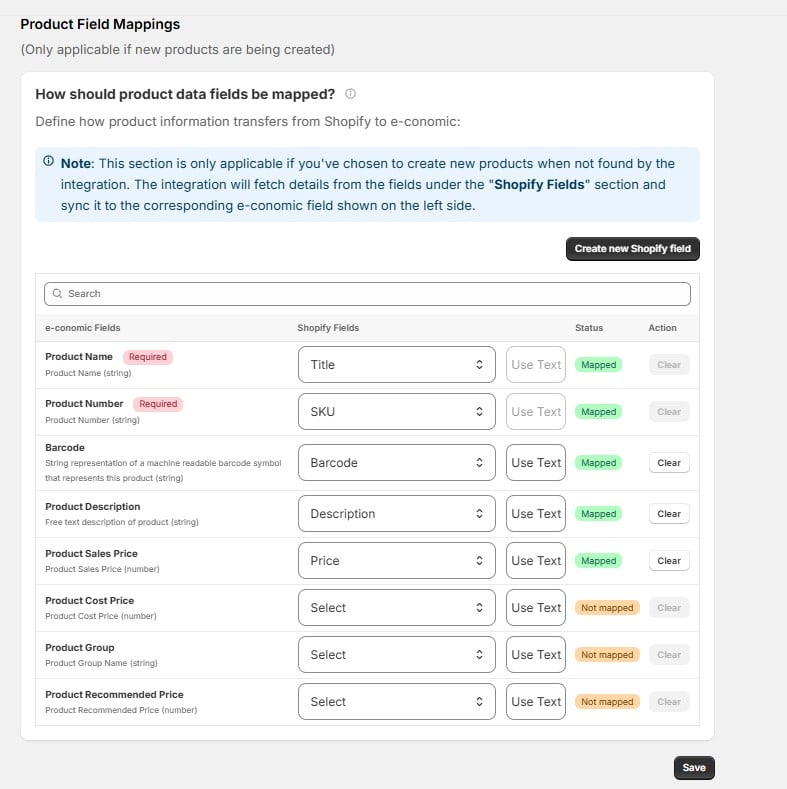 For each field you can pick a Shopify field from the dropdown, click **Use Text** to set one fixed value for all products, or click **Clear** to leave the field empty. If the data you need does not exist in Shopify, **Create new Shopify field** adds a custom field to hold it. Use the search box to find a field quickly.
Click **Save** when done.
For each field you can pick a Shopify field from the dropdown, click **Use Text** to set one fixed value for all products, or click **Clear** to leave the field empty. If the data you need does not exist in Shopify, **Create new Shopify field** adds a custom field to hold it. Use the search box to find a field quickly.
Click **Save** when done.